The discussion over the new sound of F1 is still looming, although it hasn't been a week since the continental circus left Melbourne. There's no reason to think, though, that people will not befriend the new experience, evidently something irreversibly disappeared from The Greatest Show On Earth.
Showing posts with label grand prix. Show all posts
Thursday, 20 March 2014
Long Live GP1 - The NFSW Twin of F1 aka "Bernie's Revenge"
The discussion over the new sound of F1 is still looming, although it hasn't been a week since the continental circus left Melbourne. There's no reason to think, though, that people will not befriend the new experience, evidently something irreversibly disappeared from The Greatest Show On Earth.
Thursday, 6 March 2014
How The 2014 Engine Regulations Could Tear F1 Apart
F1 could possibly go through its biggest crisis since the near-split of the series five years ago. Fingers are being pointed at the new engine rules coming into force from this year on but - unfortunately - underperforming powerplants at the reliability department are merely a symptom of an inherited disease rather than the cause of a sickness.
Thursday, 7 November 2013
The Controversial and Glorious Beginnings of Grand Prix Racing
Doughnuts. Burnouts. A spinning race car. Thick treadmarks on the asphalt. A relentless scream of eight cylinders by Renault and of an international crowd just absolutely losing it. Sebastian Vettel stopped his car in the middle of the front stretch of the Buddh International Circuit in India - embraced by a massive cloud of tyre-smoke, super-stardom and four gold-pieces - being immortalized and crystallized in history as one of the all-time greats in a technical sport that happens to be one of the most popular one of all the sports around the planet. He got out of his car, threw his fists in the air as if claiming "I am the master of the Galaxy". He was, in fact, even if just for a few moments. An undisputable master of... some sort the least. He then turned back to his vehicle and bowed down in front of it - the craft of composite materials and solutions that helped him to reach the final frontiers of driverhood where only just a handful of people have gone before. As the cloud settled and the man stood tall was it clear that it was history happening. Live. History, whose pages started to fill multiple ages before, in another place. Where mankind was taking another unfamiliar, roaring step into the unknown with no professionals, just fearless daredevils with beautiful minds.
Monday, 20 May 2013
Grand Legacy movie
The beginning of Grand Prix racing and IndyCar:
Friday, 20 April 2012
Project "Grand Legacy" - a film on the birth of #F1
Also, it would give an insight to the races preceding the event: the 1905 Gordon Bennett Cup and the 1905 Vanderbilt Cup.
All this presented with contemporary F1, IndyCar and other images from various racing series.
Two work-in-progress videos from the middle of the film, showing the Vanderbilt Cup of 1905 with the images of the 1996 US 500 - where the Vanderbilt Cup was revived for the first time.
Please leave comments, and keep in mind that this is all work-in-progress, like I said, so creative advises are very much welcome.
Saturday, 30 July 2011
Friday, 3 June 2011
Does Bahrain Need F1 Right Now?
We should point out at the beginning: the case of the Bahrain Grand Prix is not a moral question on behalf of the FIA, it never has been. If it was a moral issue, then F1 wouldn't have gone there, or Hungary, or China, or South Africa for decades for that matter.
The Bahrain case is a primarily safety problem (still on behalf F1) which is unfortunately heavily rooted in moral matters. F1 has stayed out of politics so far (quite wisely) and it was words of wisdom cancelling the event from the calendar at the beginning of the year due to the Arab Spring and the unstable situation.
The FIA forcing the series to return to Bahrain later this year however broke that barrier and stepped to a yet uncharted and controversial area. Any move from now on will be examined through a magnifying glass.
First of all, no one wishes to go there. Neither the teams or the drivers, and supposedly their sponsors would stay out of controversy, too.
If a race to be held then FIA should risk the followings, for example:
- general safety hazard (á la US GP, 2001)
- self-proclaimed protesters on and off track (á la German GP, 2000)
- boycotts from teams, suppliers (á la US GP, 2005) [this could lead to highly dangerous outcomes on behalf of a disappointed audience]
- sponsors leaving, avoiding controversy (á la post-Singapore GP, 2008 case reveal)
- long-term reputation loss for the sport
...and the list could go on endlessly. Even if a race could be pulled off without any setbacks, F1 would still be accused of intervening domestic affairs of a country. The problem is, FIA had already trespassed that line.
The only reasonable solution would be to back off ASAP.
Agree? Disagree? Share your view!
Saturday, 28 May 2011
The Top 10+1 Deceased Racing Venues
Since the first cars rolling out of the manufacturers' garage doors, people have been racing cars and motorcycles. To do that, they needed some sort of environment to sacrifice at the altar to their passion. Empty fields, public roads in the country or in cities, then purpose built venues all have been serving as arenas for petrolheads and motoring enthusiasts since then. Some of these venues have been there since motoring Genesis, some of them are not. Here is a list of the top 10+1 of them.
(Editor's note: All images are courtesy of Google. click the images for the actual Google Maps/Streetview spot.)
10. Circuit Bremgarten
The Bremgarten Circuit - in the outskirts of the Swiss capital, Bern - was designed with motorcycles in mind, although when opened in 1931, motorcars soon took over and become one of the most fearsome tracks, especially under wet conditions - largely due to having virtually no straight lines and a chain of public roads. It was on Formula 1 calendar from the beginning, but the disastrous accident at the 1955 Le Mans 24 Hours lead to banning all motorsports in Switzerland. To this day, no racing was held at the venue, nor in the country except a few non-track events.
9. Bridgehampton Race Circuit
Bridgehampton, NY, USA has a long history of motor racing, dating back to 1915. Early road races proved to be such a success that lead to the establishment of the permanent Bridgehampton Race Circuit in 1957. In its prime time it served as the scenery of World Sportscar Championship, Can-Am, NASCAR, IMSA GT Championship, and it saw the return of the legendary Vanderbilt Cup in the late 60s. Few, but technical turns for sport cars. Unfortunately, due to a lack of finance, the track was was dating out quickly, and by the early seventies there were virtually no pro-events held at this place. In 1999 it was converted to a golf course. Slowing down the pace a bit, right?
8. Daytona Beach Road Course
The sands of Daytona, Florida is basically the birthplace of American motor racing. In the late 1800s, early 1900s it served as the spot of land speed record breaking, but due to the narrow dry area it quickly became unfitting as speeds were growing higher and there was a constantly decreasing forgiveness for mistakes. Thus, speed hunters moved to the Bonneville Salt Flats, racing enthusiasts went on to race at the Indianapolis Motor Speedway, and those who lacked money started racing here. The Prohibition gave rise the 'moonrunners', who, after the amendment was erased, joined the races with their tuned, outlaw cars and so NASCAR was born. The venue consisted of one long straight line on the beach, and another one on a public road, with two sharp turns. As the success of NASCAR races were growing in the fifties, the scenery was proved to be too small, only to be replaced by the Daytona International Speedway in 1959.
7. Brooklands
The first ever purpose-built racing venue, preceding IMS a few years, opening in 1907. A banked oval with three turns, also serving as an airport for smaller planes. The track is of unpaved concrete panels and was a perfect venues for V-max attempts and Grand Prix races. There was a vibrant scene until WWII broke out in 1939, and racing was stopped, moreover, it never returned for the track. Parts of the circuit are street roads, or just decaying slowly.
6. Pescara Circuit
The Pescara Circuit is the longest ever in the history of Formula 1 World Championship with its near-26km length. Two long straights meeting in an almost 90 degree-corner and zig-zag pieces of roads connecting the open ends, through towns. The track has been not unknown to Italian drivers as it was holding local races since the 1920s, and later non-champ and one official Formula 1 race event in 1957. As with every lengthy course, it proved to be too dangerous, and racing was ended in 1961.
5. Reims-Gueux
It's the beauty of the countryside, the endless hayfields that captures the eye of the trespasser between these small French villages. It hosted sports car and Grand Prix events, too, including Formula 1 races, from the late '20s all the way through the early '70s. The old grandstand and the pits are still at where they are supposed to be, would simply be a perfect backdrop for any vintage racing event.
4. Rouen-Les-Essarts
Laid out on public roads near Rouen, France, the track was a state-of-the-art one concerning its infrastructure along with its 'Nürburgringuesqe' characteristics - running deep in the forest with high-speed blind corners and its roller coaster-like height differences. Opening in one of motor sport history's greatest year, 1950, it saw several French Grand Prix races, and was considered to be technically highly demanding. This resulted in the unfortunate death of Jo Schlesser in 1968. The circuit was still open for F2 races, but ultimately it had to be closed in 1994.
3. Tripoli Circuit
Around the airport of Libya's capital, you can still find stretches of public roads that once belonged to the then-Italian colony's monstrous Grand Prix venue, opened in 1925. Everything was big here. The track with its 13-km length and few and fast corners it was designed for sole flat-out speed. This made it one of the most important events among racing tracks in the horsepower chasing, top speed seeking period. So much, that Mercedes took their regular test track, former motorcycle racetrack and converted it to a similar to it in character - thus Hockenheimring was born. The Tripoli track was an amazing sight with its enormous grandstand, the palm trees, the sand. The motoring proving grounds of the fascist-nazi regimes closed its gates in 1940.
2. AVUS
Along with the Nürbirgring, the AVUS in Berlin was an important part of Nazi Germany's propaganda. Conceived in the early 1900s, and after interrupted years' of building, it was completed in 1921, as the first stretch of Autobahn. Two long pieces of roads running in parallel, connected with a sharp turn at the Southern and a bigger one in the Northern end, making up 19km of length. The track went through several changes by cutting it in half and constructing a highly banked brick-paved 'Wall of Death' on the Northern part. Average speed was higher than of the IMS, standing for decades. Later, the 'WoD' was demolished, cutting the track in half again, and once again, concluding in 2.6km with chicanes added. Every major German race was held here, even the 1959 Formula 1 German Grand Prix. 40 years later, in 1999 it all came to an end and races were moved to the new Lausitzring.
1. Montjuïc Circuit
Maybe not the most demanding one, not the fastest, but one of the most classic one. Situated in the park of the same name in Barcelona, Spain, the venue was a host for tragedies, supreme winnings and yet the only female-obtained points in Formula 1. Just think of Jackie Stewart flying through the corners in a Tyrell and you'll see why it is number 1.
+1. Népliget
I have no excuses. I am biased. But I have common sense too, hence +1. Read more here.
Sunday, 15 May 2011
The Hungarian Grand Prix Drivers
This is the brief story of the Hungarian Grand Prix drivers.
While Hungary has always been successful in rallying, touring car races, Grand Prix competitions seemed truly like a Nirvana out of reach of the imagination. This was a false belief, though, as the Central European country started off with the biggest bang motorsport has seen up to this day.
June 26, 1906. Unknowingly, there is history in the making for motorsport in general. The first French Grand Prix is about to start at Le Mans. The origin and prototype of Formula 1 and the Le Mans 24 hours as well.
Hungarian driver, Ferenc Szisz - great friend of the Renault family and racing engineer and of the factory's competition department - is waiting for the start. He has a great racing experience by completing various motor racing events in recent years, including the Vanderbilt Cup in the USA. This time it is different, as Reanult is in top shape and they are on their home ground at the first event organised by the French Automobile Club.
A two-day endurance event torturing drivers and cars as well, the Renault and Szisz make their stand.
Unbelievable and surprising result for Renault, France and Hungary. With a half-hour lead, Szisz wins the race, with Michelin's ingenious input in the tyre-design.
This single event marked a major blow in motorsports as factories realize the great marketing opportunities in such events. Szisz himself returned for next year's French Grand Prix as well, finishing second. Shortly after he retired racing at such big events and motorsports in general, later on. He died in peace in 1944.
In the years to come there seemed to be noone continuing the legacy of Ferenc Szisz. Partly because history stepped in with WWI and Hungarians weren't much welcomed on international level. There were private competitors in the late '30s, like István de Sztrika (1938 Swiss Grand Prix competitor - Alfa Romeo) or Count Ernő Festetics (10th at the German Grand Prix of 1937 - Maserati) - son of the then fascist leader. Interestingly, the latter got into a bar fight earlier with the son Dunlop Tyres founder, James Dunlop junior in a Budapest night club, both rolling down the stairs.
László Hartmann hadn't been considered much. Even his driving instructor advised him to get a chauffeur, he was that terrible. In the late '20s though, he evolved into an unbeatable champion of the hills surrounding Budapest. In the early '30s he got his chance to qualify to a Grand Prix event with his newly acquired Bugatti, and from that moment on, every race he entered and finished was regiestered around the 7th-8th position, right behind the huge factory teams of Germany and Italy.
Hartmann in his white Bugatti T35B, at the 1933 Monaco Grand Prix
In 1935, he switched to Maserati 8CM cars, competing on the hardest tracks yet seen. His fame was so high in his own country, that the first Hungarian Grand Prix was held in 1936:
In 1937 he finished 7th on one of the most fearsome tracks ever built, the AVUS, which made Maserati thanking his achievement personally in a letter. He was everywhere from Sweden, through the Copa Ciano,the Nürburgring, South Africa, etc. On 1938 it all ended in a crash at the Tripoli Grand Prix, breaking his spine and dying in the hospital later on.
It was a mournful day for Hungarian motor racing. Especially because history put its death penalty on all future international Grand Prix hopes. Following WWII, the communist regime took over and dissociated itself from such 'imperialist opium'. The walls were holding tight for decades, but the cracks soon appeared.
Following the 1956 revolution, the Communist Party found that endless supression cannot be viable, the leash was let looser. So much, that in 1986 the first Formula 1 Grand Prix was held behind the Iron Curtain on the newly built Hungaroring, marking the second Hungarian GP.
Hopes were in a return. Will there be another Hungarian Grand Prix driver again? And right then, in 1987, something miraculous happened.
Csaba Kesjár was a fearless gokart driver and hill climb racer. His passion was clearly drawing him towards single seaters. The '80s was a golden age in Hungarian motor racing (especially inrallying). The government was putting money into sponsoring young, talented drivers, entering them into international events. Kesjár was clearly an F1 driver in the making, as he was seen in Formula Easter, Formula Ford and the German Formula 3.
At the weekend of the 1987 Hungarian Grand Prix, it all came full circle. his dreams were realised as he got his chance by sitting in the Zakspeed Formula 1 car, giving it a few laps.
It was a mournful day for Hungarian motor racing. Especially because history put its death penalty on all future international Grand Prix hopes. Following WWII, the communist regime took over and dissociated itself from such 'imperialist opium'. The walls were holding tight for decades, but the cracks soon appeared.
Following the 1956 revolution, the Communist Party found that endless supression cannot be viable, the leash was let looser. So much, that in 1986 the first Formula 1 Grand Prix was held behind the Iron Curtain on the newly built Hungaroring, marking the second Hungarian GP.
Hopes were in a return. Will there be another Hungarian Grand Prix driver again? And right then, in 1987, something miraculous happened.
Csaba Kesjár was a fearless gokart driver and hill climb racer. His passion was clearly drawing him towards single seaters. The '80s was a golden age in Hungarian motor racing (especially inrallying). The government was putting money into sponsoring young, talented drivers, entering them into international events. Kesjár was clearly an F1 driver in the making, as he was seen in Formula Easter, Formula Ford and the German Formula 3.
At the weekend of the 1987 Hungarian Grand Prix, it all came full circle. his dreams were realised as he got his chance by sitting in the Zakspeed Formula 1 car, giving it a few laps.
Csaba Kesjár in the Zakspeed Formula 1 car on the Hungaroring in 1987
It was history on wheels: the first Hungarian driver in a Grand Prix car half a century later, and the first driver in a Formula 1 car. Unfortunately, this dream was short-lived, too. Due to a brake-failure at the Norisring F3 race in 1988, he suffered fatal injuries, crashing into the tyre-wall.
When Csaba Kesjár was a star in Formula cars, Zsolt Baumgartner was just learning to walk. In the late '90s he was following the same path as Kesjár, and fortunately for him, he had the family background to make his dream realised. In 2002 he was granted a chance to test drive a Jordan F1 car, and in 2003, he became a regular test driver. At the Qualifying of the Hungarian Grand Prix, something terrible and fantastic happened. Ralph Firman crashed and was taken to hospital for an examination. The very first F1 start for a Hungarian driver at the Hungarian Grand Prix, and the second Eastern European in the sport.
Jordan sacked him et the end of the year, but a new contract (highly supported by the state-owned Hungarian Oil Company (MOL)) was in the way with Minardi. Minardi was one of the smallest teams in F1, but many future starts started here, like the two-time World Champion Fernando Alonso.
...and then, in 2004, something truly unexpected happened at the United States Grand Prix in Indianapolis. The first Hungarian F1 point was wainting at the Brickyard. Watch Hungarian commentator, László Palik, losing his mind as Fishicella's car is giving up:
That is history, right there. Later, he joined the Minardi ChampCar team, but the team later retired from the series.
The question is still open since then: who will be the next Hungarian F1 driver? Norbert Michelisz WTCC race winner? Pál Tamás Kiss GP3 racer? That is a story still to be told.
Saturday, 19 February 2011
The Not Quite Told Story of The First Hungarian Grand Prix
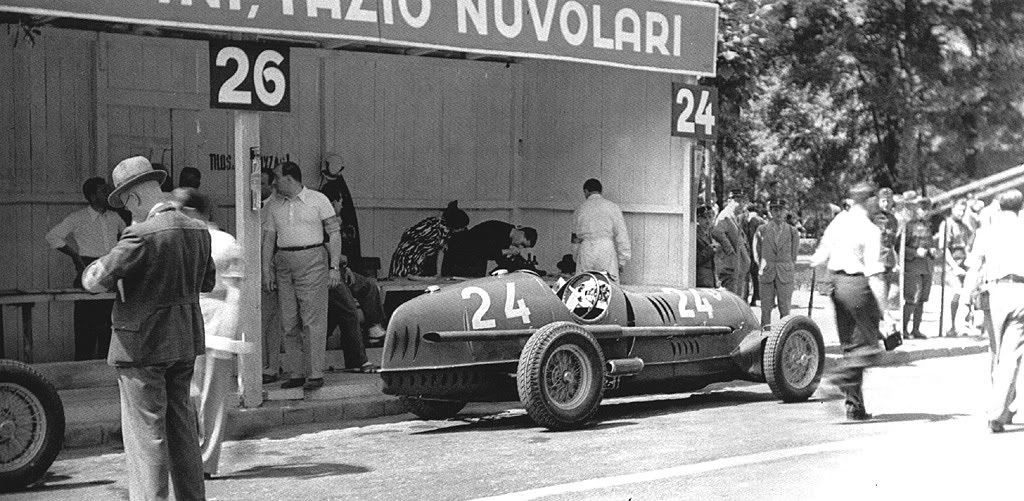
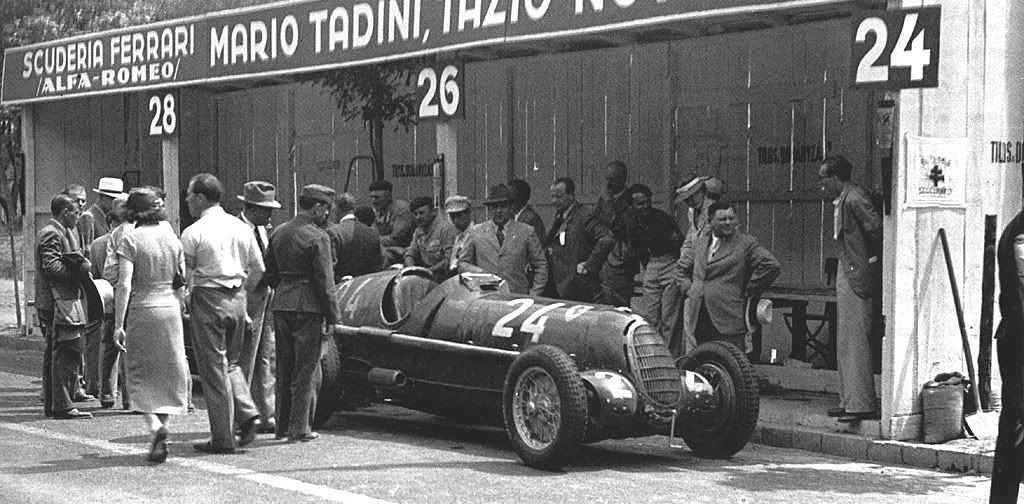
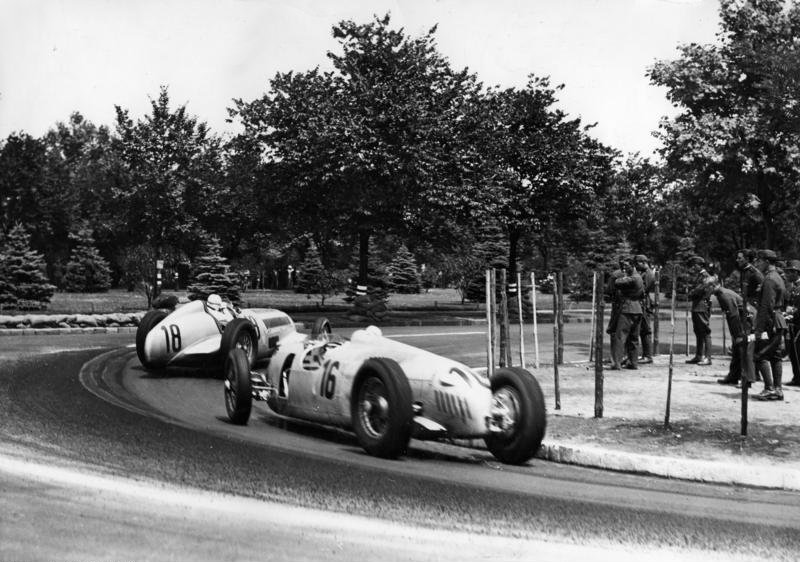
As a part of this propaganda, a Grand Prix race is getting organised for the people to see all the legendary racing drivers of the time and their cars. On June 21st, the audience is to witness the battle between such racers as Bernd Royemeser, Tazio Nuvolari, and even the Romanian Petre Cristea is allegedly among the entrants with the same specially built and tuned Ford V8 with which he participated on the Monte Carlo Rally earlier.
The circuit is set in Népliget ('people's park').
Beautiful backdrops, spectacular city at the time and bad advertisement (the church on the image below is in Szeged, not Budapest - photo from imageshack).
Dennis Davis describes the event as:
In the previous year the cars from Mercedes-Benz dominated the Grand Prix scene and captured nine of the eleven major events they entered. These victories included the Monaco, French, Belgian and Swiss Grands Prix and resulted in the crowning of the original regenmeister (rainmaster), Rudolf Caracciola as European Champion. Of their losses last year, none was more painful than Tazio Nuvolari’s legendary victory in the German Grand Prix driving a Scuderia Ferrari entered Alfa Romeo.
(photo credit: f1-gradprixhistory.net)
The starting grid looked so:
12
Stuck
Auto Union
2m39.83s
16
Rosemeyer
Auto Union
2m38.15s
24
Nuvolari
Alfa Romeo
2m40.08s
22
Brauchitsch
Mercedes-Benz
2m39.87s
14
Varzi
Auto Union
2m43.12s
18
Caracciola
Mercedes-Benz
2m40.38s
20
Chiron
Mercedes-Benz
2m49.65s
28
Tadini
Alfa Romeo
2m47.52s
10
L Hartmann
Maserati
3m10.56s
4
A Dobson
Alfa Romeo
2m53.21s
6
Martin
Alfa Romeo
3m02.51s
(credit: kolumbus.fi)
The flag dropped and Rosemeyer surged into the lead, followed by von Brauchitsch, Caracciola and Nuvolari. Caracciola then stole the lead and held it for the next 16 laps before he was forced to retire with engine failure.
While von Brauchitsch and Nuvolari were involved in a war of nerves Rosemeyer who had started behind the leading pack assumed the lead. Von Brauchitsch never the calmest driver in the field began to wilt under the pressure exerted by the Italian. Coming into a corner too fast only to spin out, von Brauchitsch was narrowly missed by the Alfa Romeo. It was now just after half distance and Nuvolari had his eyes set on the race leader Rosemeyer. Each earlier call for his retirement would now serve to fuel Nuvolari’s efforts. Slowly he reeled in his young rival and on the 33rd lap Nuvolari made his move and passed the Auto Union for the lead. Nuvolari continued to extend his lead until the end thereby avenging his defeat of one week ago. Von Brauchitsch, the last Mercedes still in the race spun again two laps from the finish and suffered terminal damage to his car. Alfred Neubauer, the Mercedes team manager flung down his control flags in disgust.
Finishing results:
1. 24 Tazio Nuvolari Scuderia Ferrari Alfa Romeo 8C-35 3.8 S-8 50 2h14m03.5s =
2. 16 Bernd Rosemeyer Auto Union AG Auto Union C 6.0 V-16 50 + 14.2
3. 14 Achille Varzi Auto Union AG Auto Union C 6.0 V-16 48
4. 28 Mario Tadini Scuderia Ferrari Alfa Romeo 8C-35 3.8 S-8 47
5. 12 H. Stuck / /E. von Delius Auto Union AG Auto Union C 6.0 V-16 46
6. 4 Austin Dobson A. Dobson Alfa Romeo Tipo B/P3 3.2 S-8 45
7. 10 László Hartmann L. Hartmann Maserati 8CM 3.0 S-8 44
DNF 22 Manfred von Brauchitsch Daimler-Benz AG Mercedes-Benz W25K 4.7 S-8 40 crash
DNF 6 Charles Martin C. Martin Alfa Romeo Tipo B/P3 2.9 S-8 32 rear axle 35 laps?
DNF 18 Rudolf Caracciola Daimler-Benz AG Mercedes-Benz W25K 4.7 S-8 26 engine (crash?)
DNF 20 Louis Chiron Daimler-Benz AG Mercedes-Benz W25K 4.7 S-8 19 engine/supercharger
50 years later a new race was organised under new rules, new circumstances, at a new place. The former track is still available to the public partly in car traffic use, partly as a recreational green area. 2011 sees the 75th anniversary of that legendary race and the 26th Grand Prix of Hungary.
Wednesday, 26 January 2011
Drive in Technicolor
Almost every WWII movies have to reflect an almost black and wthie colorscheme because that's how people remember it: the footages they saw on TV.
That is how I remember motorsports as well. I can see Jackie Stewart with long hair and a beard that looks like was left unfinished due to budget restrictions. And everything is brownish and has the whole celluloid film feel. The highest appreciation for anyone apperaing on screen is being filmed on celluloid and then projected to movie screens in front of live audience.
There were no live onboard cameras and presentation live was a bit clumsy. TV never appeared to surpass the quality and atmosphere of what you get a recorded, treated, cut, projected, commonly adsorbed experience.
I love this period of racing documentaries. The narrator gives us the ultimate insider guide noone else could do. Nowadays this is all gone due to the informative luxury of the Internet.
Those people still live but may remember in the same method as they are being presented in these footages since they have met them so many times since their recording.
The cars, the feel, the vibe lives on in films. You associate the colours, the texture, the lightning, the montage, everything to that period, it is almost unacceptable to present these otherwise.
This is the code, the dogma.
But this is just a semi-solution.
The distorted reality becomes the collective reality.
Such as the case when talking about cars. Watching 30s Grand Prix or 80s Group B moments there is a certain vocabulary you have to address upon discussing.
You have to say 'these people were crazy to drive these and the audience was crazy to watch from that close'. Well, it depends.
Several drivers thought it wasn't anything too special to drive under such conditions. The standard was set: be the fastest, whatever it takes. Concerning the audience... well... I think those people form the past would call YOU crazy watching everything on TV. You may get a full HD/3D, Surround experience selecting cameras, but you are simply not there.
When being there, you may not see anything or just eventual flashes, but... gosh, you ARE there. The spirit is there, the atmosphere is there.
That's what they remember. What you are going to remember is the camera angles and the colorscheme being used on screen.
Every memory fades. But every piece of memory is being preserved somewhere. Some sort of machinery recorded the event. That is what every future generation will remember.
But let the witnesses be praised in the first place... for simply not being able to reproduce the feel... but for just seeing that smile on their faces.
Friday, 12 March 2010
Sunday, 21 February 2010
NOTE: Pioneers
Labels:
1906,
ferenc szisz,
formula 1,
grand prix,
hungarian,
hungaroring,
hungary,
le mans,
motor racing,
renault,
szisz ferenc
Sunday, 14 February 2010
Subscribe to:
Posts (Atom)