Hungary's 1981 racing documentary, titled "Autóversenyzők" (i.e. "Race Car Drivers") is somewhat of a cult flick among motoring enthusiasts for more than one reason: it has proper racing and rallying footage from an era where there weren't cameras lying around by the hundreds to cover an event, but mostly because it features cars that are getting even rarer each day passing - even in countries of the ex-Eastern Block - that make one part of ex-Westerners go yawning, the rest of them glued to their screens. The movie is - of course - in Hungarian, but I will give you some description to all the commentary that is provided by either the narrator or the racers themselves. Okay, buckle up, nine-piece playlist.
Showing posts with label hungary. Show all posts
Showing posts with label hungary. Show all posts
Thursday, 21 November 2013
Do You Have Patience to Watch 90-min. Vintage Racing & Gibberish?
Hungary's 1981 racing documentary, titled "Autóversenyzők" (i.e. "Race Car Drivers") is somewhat of a cult flick among motoring enthusiasts for more than one reason: it has proper racing and rallying footage from an era where there weren't cameras lying around by the hundreds to cover an event, but mostly because it features cars that are getting even rarer each day passing - even in countries of the ex-Eastern Block - that make one part of ex-Westerners go yawning, the rest of them glued to their screens. The movie is - of course - in Hungarian, but I will give you some description to all the commentary that is provided by either the narrator or the racers themselves. Okay, buckle up, nine-piece playlist.
Monday, 20 May 2013
Grand Legacy movie
The beginning of Grand Prix racing and IndyCar:
Sunday, 28 August 2011
Light Years Away
What do you do when you have run out of funds, hope of a better future and patience? You set your car's nose England-bound.
It all started over two years ago when talks started between my wife and I that we sould join all those people who in wish to grab fortune's better end set themselves to Western and Northern Europe. There were initiatives taken and withdrawn when finally tensions within our broader family and lack of funds lead to concrete decisions and conclusions at the end of last year and the whole procedure of moving started taking shape.
The setting looked like so: me, my wife, two dogs and all that one could fill in a Ford Escort. Printed Google Maps directions, over three tanks of fuel and 1,200 miles to cover from Kaposvar, Hungary to Keynsham, UK.
Saturday, 30 July 2011

Friday, 15 July 2011
Wild East
(Originally published at http://www.nz-hotrod.com/vbulletin/printthread.php?t=4028&pp=40 on 29th May, 2009)
„So, what is it like where you live, Wilson?” I asked my old friend from Tennessee, America. It was quiet. The lake had been within the distance of throwing a stone, the field was busy with crickets and some deers were mating in the forest according to the noises we heard. Besides that, only the exhausted engine was cracking behind us, the only technological monster in this scenery. „Pretty much like this…” he answered. He stared into the distance. So did I for almost an hour. We were enjoying peace for a while. Heading back to the civilization I looked in the mirror while taking the forest route. Wilson was sleeping on the back seat… or praying, I couldn’t tell. Maybe he was just dreaming about God. I was wondering. We were seperated by thousands of miles in distance, a thousand years of culture, approximately 40 years in age but we still had something in common. If he hadn’t been a committed Christian he could have easily been a moonshine runner as well – I was thinking. Although we didn’t have booze in the trunk (for both of us had been on a mission) nor a V8 under the hood we were still riding fast deep in the forest… just like a moonrunner. Wilson just not happened to notice this. But I tell you, it was a real hot ride in the woods, somewhere in South-West of Hungary…
Sunday, 15 May 2011
The Hungarian Grand Prix Drivers
This is the brief story of the Hungarian Grand Prix drivers.
While Hungary has always been successful in rallying, touring car races, Grand Prix competitions seemed truly like a Nirvana out of reach of the imagination. This was a false belief, though, as the Central European country started off with the biggest bang motorsport has seen up to this day.
June 26, 1906. Unknowingly, there is history in the making for motorsport in general. The first French Grand Prix is about to start at Le Mans. The origin and prototype of Formula 1 and the Le Mans 24 hours as well.
Hungarian driver, Ferenc Szisz - great friend of the Renault family and racing engineer and of the factory's competition department - is waiting for the start. He has a great racing experience by completing various motor racing events in recent years, including the Vanderbilt Cup in the USA. This time it is different, as Reanult is in top shape and they are on their home ground at the first event organised by the French Automobile Club.
A two-day endurance event torturing drivers and cars as well, the Renault and Szisz make their stand.
Unbelievable and surprising result for Renault, France and Hungary. With a half-hour lead, Szisz wins the race, with Michelin's ingenious input in the tyre-design.
This single event marked a major blow in motorsports as factories realize the great marketing opportunities in such events. Szisz himself returned for next year's French Grand Prix as well, finishing second. Shortly after he retired racing at such big events and motorsports in general, later on. He died in peace in 1944.
In the years to come there seemed to be noone continuing the legacy of Ferenc Szisz. Partly because history stepped in with WWI and Hungarians weren't much welcomed on international level. There were private competitors in the late '30s, like István de Sztrika (1938 Swiss Grand Prix competitor - Alfa Romeo) or Count Ernő Festetics (10th at the German Grand Prix of 1937 - Maserati) - son of the then fascist leader. Interestingly, the latter got into a bar fight earlier with the son Dunlop Tyres founder, James Dunlop junior in a Budapest night club, both rolling down the stairs.
László Hartmann hadn't been considered much. Even his driving instructor advised him to get a chauffeur, he was that terrible. In the late '20s though, he evolved into an unbeatable champion of the hills surrounding Budapest. In the early '30s he got his chance to qualify to a Grand Prix event with his newly acquired Bugatti, and from that moment on, every race he entered and finished was regiestered around the 7th-8th position, right behind the huge factory teams of Germany and Italy.

Hartmann in his white Bugatti T35B, at the 1933 Monaco Grand Prix
In 1935, he switched to Maserati 8CM cars, competing on the hardest tracks yet seen. His fame was so high in his own country, that the first Hungarian Grand Prix was held in 1936:
In 1937 he finished 7th on one of the most fearsome tracks ever built, the AVUS, which made Maserati thanking his achievement personally in a letter. He was everywhere from Sweden, through the Copa Ciano,the Nürburgring, South Africa, etc. On 1938 it all ended in a crash at the Tripoli Grand Prix, breaking his spine and dying in the hospital later on.
It was a mournful day for Hungarian motor racing. Especially because history put its death penalty on all future international Grand Prix hopes. Following WWII, the communist regime took over and dissociated itself from such 'imperialist opium'. The walls were holding tight for decades, but the cracks soon appeared.
Following the 1956 revolution, the Communist Party found that endless supression cannot be viable, the leash was let looser. So much, that in 1986 the first Formula 1 Grand Prix was held behind the Iron Curtain on the newly built Hungaroring, marking the second Hungarian GP.
Hopes were in a return. Will there be another Hungarian Grand Prix driver again? And right then, in 1987, something miraculous happened.
Csaba Kesjár was a fearless gokart driver and hill climb racer. His passion was clearly drawing him towards single seaters. The '80s was a golden age in Hungarian motor racing (especially inrallying). The government was putting money into sponsoring young, talented drivers, entering them into international events. Kesjár was clearly an F1 driver in the making, as he was seen in Formula Easter, Formula Ford and the German Formula 3.
At the weekend of the 1987 Hungarian Grand Prix, it all came full circle. his dreams were realised as he got his chance by sitting in the Zakspeed Formula 1 car, giving it a few laps.


It was a mournful day for Hungarian motor racing. Especially because history put its death penalty on all future international Grand Prix hopes. Following WWII, the communist regime took over and dissociated itself from such 'imperialist opium'. The walls were holding tight for decades, but the cracks soon appeared.
Following the 1956 revolution, the Communist Party found that endless supression cannot be viable, the leash was let looser. So much, that in 1986 the first Formula 1 Grand Prix was held behind the Iron Curtain on the newly built Hungaroring, marking the second Hungarian GP.
Hopes were in a return. Will there be another Hungarian Grand Prix driver again? And right then, in 1987, something miraculous happened.
Csaba Kesjár was a fearless gokart driver and hill climb racer. His passion was clearly drawing him towards single seaters. The '80s was a golden age in Hungarian motor racing (especially inrallying). The government was putting money into sponsoring young, talented drivers, entering them into international events. Kesjár was clearly an F1 driver in the making, as he was seen in Formula Easter, Formula Ford and the German Formula 3.
At the weekend of the 1987 Hungarian Grand Prix, it all came full circle. his dreams were realised as he got his chance by sitting in the Zakspeed Formula 1 car, giving it a few laps.


Csaba Kesjár in the Zakspeed Formula 1 car on the Hungaroring in 1987
It was history on wheels: the first Hungarian driver in a Grand Prix car half a century later, and the first driver in a Formula 1 car. Unfortunately, this dream was short-lived, too. Due to a brake-failure at the Norisring F3 race in 1988, he suffered fatal injuries, crashing into the tyre-wall.
When Csaba Kesjár was a star in Formula cars, Zsolt Baumgartner was just learning to walk. In the late '90s he was following the same path as Kesjár, and fortunately for him, he had the family background to make his dream realised. In 2002 he was granted a chance to test drive a Jordan F1 car, and in 2003, he became a regular test driver. At the Qualifying of the Hungarian Grand Prix, something terrible and fantastic happened. Ralph Firman crashed and was taken to hospital for an examination. The very first F1 start for a Hungarian driver at the Hungarian Grand Prix, and the second Eastern European in the sport.
Jordan sacked him et the end of the year, but a new contract (highly supported by the state-owned Hungarian Oil Company (MOL)) was in the way with Minardi. Minardi was one of the smallest teams in F1, but many future starts started here, like the two-time World Champion Fernando Alonso.
...and then, in 2004, something truly unexpected happened at the United States Grand Prix in Indianapolis. The first Hungarian F1 point was wainting at the Brickyard. Watch Hungarian commentator, László Palik, losing his mind as Fishicella's car is giving up:
That is history, right there. Later, he joined the Minardi ChampCar team, but the team later retired from the series.
The question is still open since then: who will be the next Hungarian F1 driver? Norbert Michelisz WTCC race winner? Pál Tamás Kiss GP3 racer? That is a story still to be told.
Saturday, 19 February 2011
The Not Quite Told Story of The First Hungarian Grand Prix
 1936. Hungary's straight headed to WWII. After a horrific loss of territory and dignity in WWI, Hungary is making alliances with Nazi Germany and fascist Italy in seek for revenge. Zeppelins cruise in the skies, the propaganda is getting stronger and stronger.
As a part of this propaganda, a Grand Prix race is getting organised for the people to see all the legendary racing drivers of the time and their cars. On June 21st, the audience is to witness the battle between such racers as Bernd Royemeser, Tazio Nuvolari, and even the Romanian Petre Cristea is allegedly among the entrants with the same specially built and tuned Ford V8 with which he participated on the Monte Carlo Rally earlier.
The circuit is set in Népliget ('people's park').
Beautiful backdrops, spectacular city at the time and bad advertisement (the church on the image below is in Szeged, not Budapest - photo from imageshack).

Dennis Davis describes the event as:
In the previous year the cars from Mercedes-Benz dominated the Grand Prix scene and captured nine of the eleven major events they entered. These victories included the Monaco, French, Belgian and Swiss Grands Prix and resulted in the crowning of the original regenmeister (rainmaster), Rudolf Caracciola as European Champion. Of their losses last year, none was more painful than Tazio Nuvolari’s legendary victory in the German Grand Prix driving a Scuderia Ferrari entered Alfa Romeo.
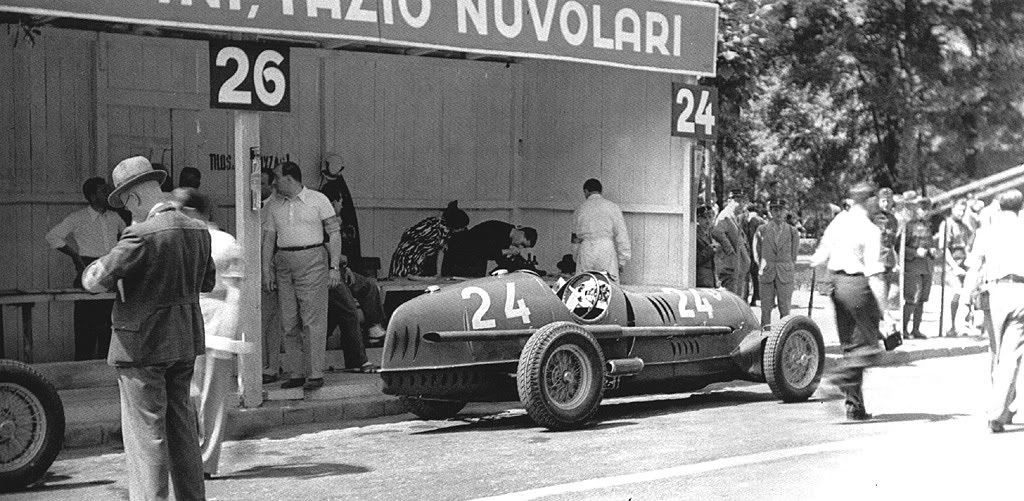
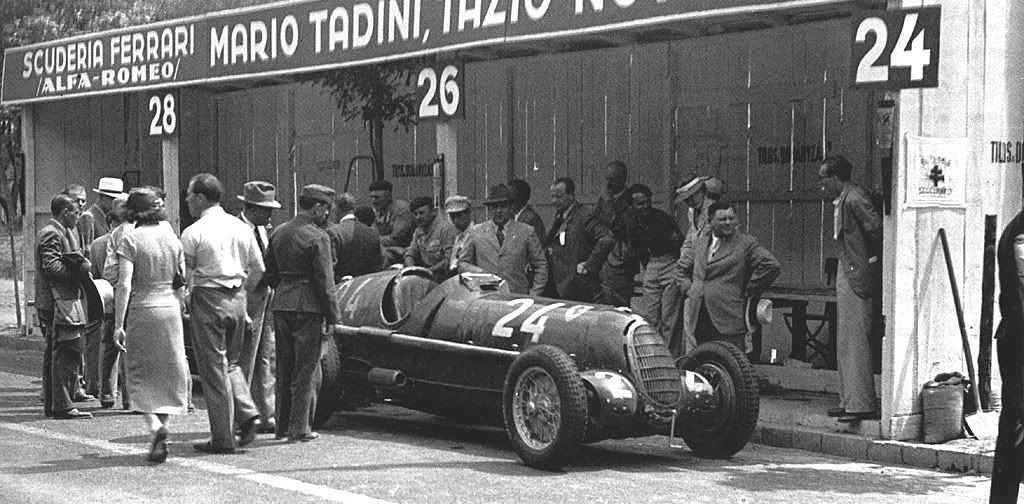
(photo credit: f1-gradprixhistory.net)
The starting grid looked so:
12
Stuck
Auto Union
2m39.83s
16
Rosemeyer
Auto Union
2m38.15s
24
Nuvolari
Alfa Romeo
2m40.08s
22
Brauchitsch
Mercedes-Benz
2m39.87s
14
Varzi
Auto Union
2m43.12s
18
Caracciola
Mercedes-Benz
2m40.38s
20
Chiron
Mercedes-Benz
2m49.65s
28
Tadini
Alfa Romeo
2m47.52s
10
L Hartmann
Maserati
3m10.56s
4
A Dobson
Alfa Romeo
2m53.21s
6
Martin
Alfa Romeo
3m02.51s
(credit: kolumbus.fi)
The flag dropped and Rosemeyer surged into the lead, followed by von Brauchitsch, Caracciola and Nuvolari. Caracciola then stole the lead and held it for the next 16 laps before he was forced to retire with engine failure.
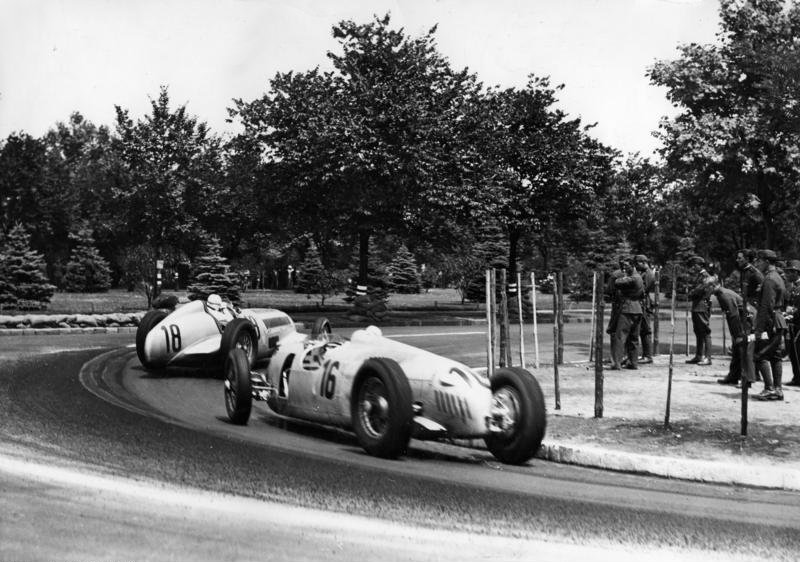
While von Brauchitsch and Nuvolari were involved in a war of nerves Rosemeyer who had started behind the leading pack assumed the lead. Von Brauchitsch never the calmest driver in the field began to wilt under the pressure exerted by the Italian. Coming into a corner too fast only to spin out, von Brauchitsch was narrowly missed by the Alfa Romeo. It was now just after half distance and Nuvolari had his eyes set on the race leader Rosemeyer. Each earlier call for his retirement would now serve to fuel Nuvolari’s efforts. Slowly he reeled in his young rival and on the 33rd lap Nuvolari made his move and passed the Auto Union for the lead. Nuvolari continued to extend his lead until the end thereby avenging his defeat of one week ago. Von Brauchitsch, the last Mercedes still in the race spun again two laps from the finish and suffered terminal damage to his car. Alfred Neubauer, the Mercedes team manager flung down his control flags in disgust.
Finishing results:
1. 24 Tazio Nuvolari Scuderia Ferrari Alfa Romeo 8C-35 3.8 S-8 50 2h14m03.5s =
2. 16 Bernd Rosemeyer Auto Union AG Auto Union C 6.0 V-16 50 + 14.2
3. 14 Achille Varzi Auto Union AG Auto Union C 6.0 V-16 48
4. 28 Mario Tadini Scuderia Ferrari Alfa Romeo 8C-35 3.8 S-8 47
5. 12 H. Stuck / /E. von Delius Auto Union AG Auto Union C 6.0 V-16 46
6. 4 Austin Dobson A. Dobson Alfa Romeo Tipo B/P3 3.2 S-8 45
7. 10 László Hartmann L. Hartmann Maserati 8CM 3.0 S-8 44
DNF 22 Manfred von Brauchitsch Daimler-Benz AG Mercedes-Benz W25K 4.7 S-8 40 crash
DNF 6 Charles Martin C. Martin Alfa Romeo Tipo B/P3 2.9 S-8 32 rear axle 35 laps?
DNF 18 Rudolf Caracciola Daimler-Benz AG Mercedes-Benz W25K 4.7 S-8 26 engine (crash?)
DNF 20 Louis Chiron Daimler-Benz AG Mercedes-Benz W25K 4.7 S-8 19 engine/supercharger
50 years later a new race was organised under new rules, new circumstances, at a new place. The former track is still available to the public partly in car traffic use, partly as a recreational green area. 2011 sees the 75th anniversary of that legendary race and the 26th Grand Prix of Hungary.
Sunday, 21 February 2010

Sunday, 14 February 2010

Subscribe to:
Posts (Atom)


